Article
A personalised AI answer starts with your data
A question about your own income calls for your own figures. With a digital wallet, you can share that data when an AI assistant needs it. The conversation can then move on to a calculation and an answer about your situation.
“I have two jobs. Will I have to pay extra tax?” Noor asks an AI assistant. It can explain how income and tax relate to each other. To answer Noor's question, it needs her figures: how much has she earned from each employer, how much tax has already been withheld and which tax credits have been applied?
That information is on her annual income statements and payslips. Noor can type in amounts or upload documents, but doing so does not establish that the data really comes from her employers, is unchanged and relates to her. A mistyped amount or an altered document can lead the assistant astray. It could then give convincing advice that does not fit Noor's actual situation.
Digital credentials from a wallet make it possible to check the source of the data and its link to Noor before the assistant uses it in a calculation. That gives it a verifiable basis for its calculation and answer.
The assistant asks for what it needs
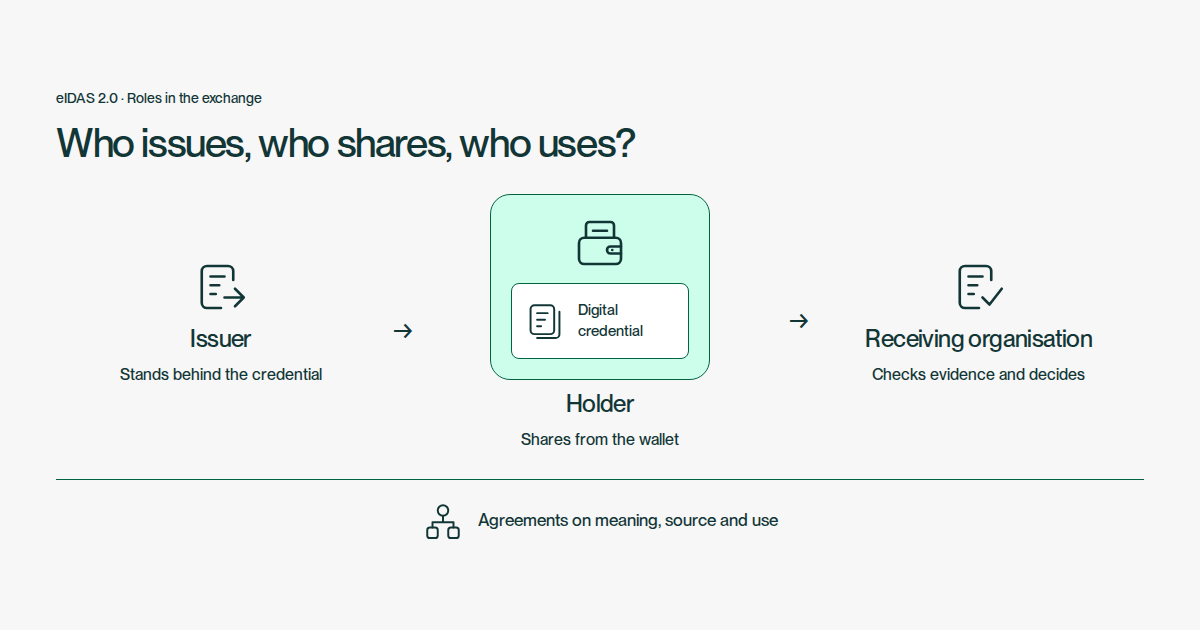
Suppose Noor has received income data from the Dutch Tax Administration, a record of salary payments from her bank and payroll information from her employers in her wallet. Those organisations have issued the data to her themselves as digital credentials. With Noor's permission, the AI assistant can request this information and use it in its calculation.
From the chat, the AI assistant starts a request for the income data needed to answer her question. This includes her annual income from each employer, the tax withheld and the periods during which the Dutch payroll tax credit, loonheffingskorting, was applied. In the conversation, it explains what it wants to do with the data: look at both incomes together and check whether the periods in which the credit was applied overlap.
Noor confirms in her wallet which data she wants to share. The assistant receives her income data and can use it to look into her original question. This gives the conversation a basis in her own situation.
Wallets bring verifiable data into the AI conversation
In Noor's case, data from two employers comes together in one conversation. The assistant can consider the figures together, with each amount still linked to the relevant employer and year. It can then explain which data it used for its answer.
This is the value of wallets for AI: personal data from different organisations becomes usable in the conversation where someone is seeking help. Users choose what they share. The assistant can tailor its answer to that data and show where it comes from. Users gain both personalised support and insight into the information on which that support is based.
From an income question to other uses
When the necessary data is available as digital credentials, this approach can help with a range of questions.
For a question such as “How much do I have left each month?”, an assistant can compare income and regular outgoings. Using the data someone shares from their wallet, it can create an overview and show what remains after those expenses.
The same approach can help with a next step in work or education. Someone asking “Which further course builds on my diploma?” can share a diploma and professional qualifications from their wallet. The assistant can compare these with course entry requirements and explain which courses are a match and which additional qualifications are still needed.
Personal context also helps with questions for a service provider. To answer “When can I change my subscription?”, the assistant can combine subscription data from the wallet with the provider's terms. It can then explain which changes are possible and when they can take effect.
How Ver.iD helps
For organisations developing these AI assistants, the Ver.iD platform provides the connection to wallets. You decide which data you need and which issuers you trust. Through the platform, you request the data and verify the digital credentials. Your AI application can then use the shared data to help the user.